| MTAB/LKAB IORE | Dm3 |
|---|---|
|
|
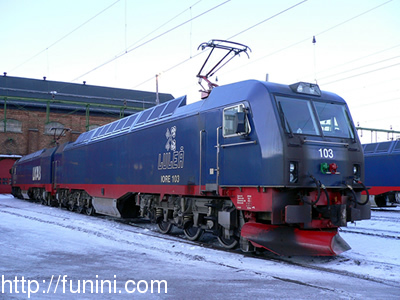
| The strongest locomotive in the world is here in Sweden. Although its maximum speed is only 80 km/h, its traction force is 1200kN. | The older type locomotive in Narvik-Kiruna-Luleå line. The rod-style traction system enabled to load huge motor, but it has also caused strong vibration. |
| SJ X2000 (X2) | SJ X40 | ||
|---|---|---|---|
|
|
|
|
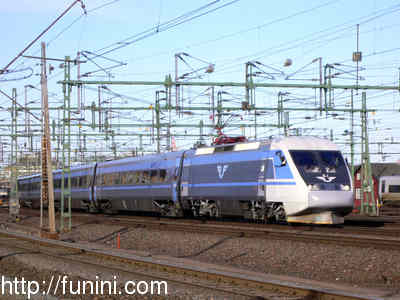
| X2000 has given a great impact on Swedish Railway. Not only achieved 200km/h, it is the first EMU that was put into long-distance services. Although it has withdrown from Lynx service (Norway-Sweden-Denmark), it is still in the flagship poition in SJ. Currently renovations are going on, and refurblished units are painted in gray. | Currently SJ is putting new X40 series into service. It has double-deck passengers cabin and ability of 200 km/h. | ||
| SJ X50 Series (X50, X51, X52, X53) | SJ X10 Series (X11, X12, X13, X14) | Arlanda Express (X3) | |
|
|
|
|
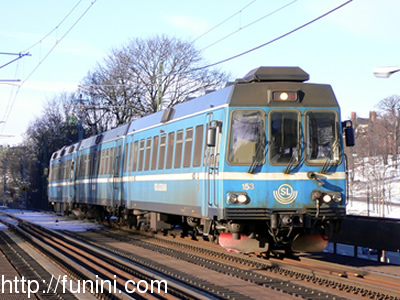
| SL EMU X60 in Stockholm | SL EMU X10 in Stockholm | SL EMU X1 in Stockholm | C20 SL/Connex (Stockholm Subway) |
|---|---|---|---|
|
|
|
|
| The new subway cars uses shared-bogie style -- three bodies shares four bogies. Each body has only 14m, which enables to fit well in a curve. | |||
| Cx SL/Connex (Stockholm Subway) | Roslagsbanan (SL - Stockholm) | Tram in Stockholm, Series A32 | Lidingöbanan, Series A30, B30 |
|
|
|
|
| Roslagsbanan runs in the north of Stockholm. The guage is narrow (891mm), so even the newest cars use old type driving system. Everything in this line is on a small scale. | Two tram lines have survivied after the closure of tram network in 1967 in Stockholm. Lidingöbanan connects Ropsten (one of the last station of T-bana) and Lidingö island, and Nockebybanan is a branch from another T-bana line. One new line was additionally opened in 2000 -- Tvärbanan. It runs circularly in Stockholm, and connects every radial line. |
| Göteborg Tram (Trikken) | Norrköping Tram |
|---|---|
|
|
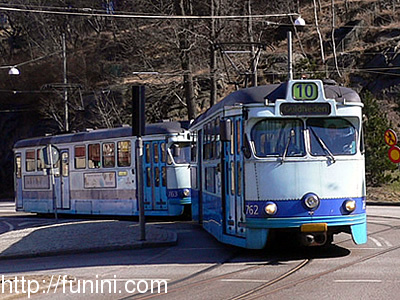
| Göteborg has the most developed tram network now. In 1960s, the tram was thought to stop its service before long; after the energy crisis, it has been run over and some new lines opened. Suburban lines have subway-like facilities, but the performance of rolling stocks limits their speed. |