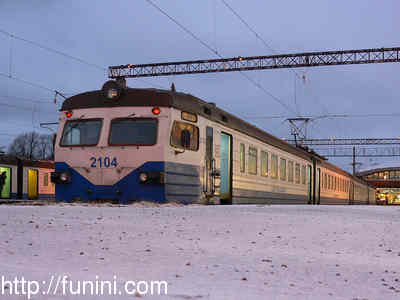
Here are some photos of Finnish trains. Although Finland does not have large inhabitants, trains have developed well based on financial aid from the government. The temperature reaches -40 degrees cencius in Lapland, trains run almost punctually. Rolling stocks are also specially designed to overcome the hard winter.
Trains of VR are clean and comfortable. Most of the tolling stocks are designed specially for Finland. The newest locomotive Sr2 or Pendolino have its origin in Switzerland or Italy, but they have special features such as additional heaters or bogies for 1524mm-width-tracks.
* Click each photo to see the detail.
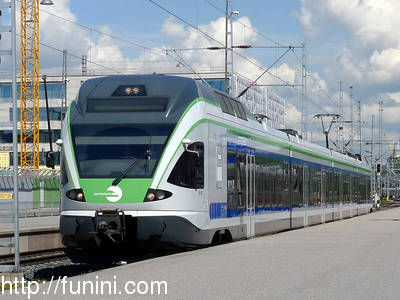
Pendolino "S220" is a new express train designed in Italy. It has 220km/h max. speed and tilting mechanism. Now it runs not only between Helsinki and Tampere, its service reached Oulu, Kuopio and Joensuu. However, its tilting mechanism is not fully used in conventional lines.
Sm1 is the oldest EMU in Finland, which was designed and manufactured in Finland. Although it is not lightweight, the series are very tough against low temperatures and snowfalls. Originally painted yellow and red, but Now every Sm1 stock is refurblished and colored in red and white.
Sm2 is the improved series of Sm1. It has alminum body and air suspension bogies, looking a little smarter than Sm1. In 2005, most stocks had original yellow and red style. For a long time, these EMU have been used near Helsinki, but recently they are also in service near Tampere and Lahti.
After refurblishment of Sm1, refurblishment of Sm2 has begun in 2005. Seats are impeoved, some decks are removed, and color schema are dynamically changed. Although Sm1 has lost its curved windshield on its removation, Sm2 holds it, maybe because its alminum body are not aged much.
Sm4 is in serivce since 2003, designed by Fiat, Italy. While one trainset consists of two stocks, motors are equipped on the boggies near cabin, and most part are low-floored. Its max. speed is 160km/h, which is fully utilized in new high-speed line bound for Lahti.
Sr1 is the first electric locomotive in Finland. It was manufactured in Soviet Union, but electric equipments are provided from Finland. Originally its max. speed was 120km/h, but some of them were renovated to run 160km/h. In 2006, Sr1 are as widely used as Sr2, except for IC2 service.
Sr2 is one of the variation of Lok2000 series, designed in Switzerland. Similar locomotives are used in many contries, such as in Norway, but Sr2 is the only one which has 1524mm gauge bogies. It acheves stable performance, and its max. speed is 230km/h (200km/h in IC2 service).
Since most main lines are electrificated, the number of diesel locomotives is continuously decreasing. Heavy DLs such as Dr16 are only used in Lapland and the line from Kuopoi - Oulu. Smaller Db12 can be seen everywhere. Switchers such as Dv12 can be seen in every terminal.
In 2006, there were 3 kinds of long-distance coaches and one regional coach. Express coaches have blue body with manual doors. IC has white and red outfit, and IC2 has a double-deck body. There are Express and IC2 style sleeping cars. All the coaches can be merged.
The blue Express type coach has been used for 40 years. It has large and comfortable seats and non-automatic doors. These stocks were a greate success, which has built hundreds of cars. These coaches are not used for ICs, but can be seen everywhere in Finland.
Type IC is improved type introduced from 1988. It is the first air-conditioned coaches in VR, with large window and automatic doors. Its color, white and red, also changed the mood of express coaches. It is mainly used in IC services combined with IC2.
The double-decker IC2 is the newest coaches in 2005. Since large standard of maximum size in Finland, both upper and lower floors have speciaous interiors. Some trains, (Helsinki-Turku/Tampere) are only composed of IC2, but most trains are combined with IC.
VR has "car-train", which carries passengers and their automobiles at the same time. There are two type of freight stocks for automobiles. The older one has normal bogies, with its side open. Newer one has one-axis bogies with shielded room for automobiles.
Most Helsinki urban trains are served by EMUs, but there are several locomotive-pulling trains for commuters. Commuter coaches, called Eil/EilF are used for these services. Its interior is similar to Sm1/Sm2, but equipped with better seats. Its outfit is red and gray.
Since the gauge of Finnish railways is the same as that of Russian, direct services run from Helsinki to St. Petersburg and Moscow. Although there are more freight trains than passengers trains, it is an important route to connect Russia to Europe. The photos are Russian coaches in 2005.
Nowadays most lines are electricified, and diesel locomotives are used in unelectricified lines since there are enough numbers of DLs. However, from 2006 Dm12 has started its operation from Tampere to Pieksämäki. Dm12 was manufactured by Skoda in Czech.
Since most of Finnish lines were not electricified before 80s, diesel motorcars played a great roll in local transports. Dm7, characterized with its round cabin, is the most typical DMU in that ages. Now Dm7 has retired, but several stocks are remaind for railway events.
Helsinki city transport is mainly operated by HKL. Although some buses have non-HKL drivers and cars, HKL takes charges of the dicision of routes and fares.
* Click each photo to see the detail.
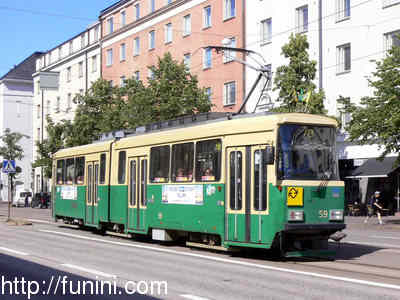
Most of the tram lines in Helsinki was opened before WW2. Tram is the most popular option to move around in the city center. It has 1000mm gauge and single-headed narrow body. Two types are mainly used: Nr1/Nr2 is made in Finland, and type 200 was made by AdTrantz. In Finnish, tram is called "Ratikka"
Nr1/Nr2 was put into service since 1980. It has high floor and chopper controlled motors. Two nodies are articulated with a biggie. In 1980s, they are painted in orange and gray, but now painted in the standard outfit --- green and yellow. Renovated cars have large destination sign over the windshield.
In 1999, new low-floor vehicles have introduced from AdTrantz. This type is named Variotram, number starts from 201. Five units are connected to form one trainset, and all the floor are the same level (about 300mm). It is single-headed, and doors are only in one side.
Car 150, 151-154 are introduced from Mannheim Tram, Germany in 2004 and 2005. Its interior is unique wooden-based with incandescent lamp. Older trams, replaced by tram 151, had a pulling style: one motor car towed one trailer. Now they are used for advertisement.
Helsinki has one metro line with a branch. It is mainly used for people in eastern Helsinki. Extension to Tapiola (in Espoo city) is going to open. Although length is short, it is full-scaled subway with 1524mm gauge, wide body. Most train cosists of 6 cars. Series 100 and 200 are being used.
Series 100 are the first rolling stocks in Helsinki Subway, in serice from 1982. It has the first-age inverter-controlled system. Interior are light and simple... color schema is orange based, and seats are made of plastic. The series do not merge with series 200.
Series M200 are introduced from 2001. Compaing to M100, it has a rounded form, but both have orange-based color schema. Its seat layout has changed a little, and two cars are connected with throughway. The series are designed by Bombardier.
* Click each photo to see the detail.
The importance of Estonian railway has decresed comparing to Sovieto union era, but urban services in Tallinn still play a important role. EMU Er2 and DMU DR1A, made in USSR, are mostly used. In tha capital Tallinn, Tatra car tram from Czech are running around, as a major city transportation.
| funini.com -> Train -> Finland |
|